

Screen Enclosure Materials in Florida: Profiles, Mesh & Sizing
Screen enclosure materials in Florida need to balance corrosion resistance, code compliance, and visibility. Screen enclosures are the single largest category of residential aluminum construction in Florida. Every pool, patio, and lanai in the state either has a screen enclosure or is a candidate for one. For contractors, understanding the materials — not just the installation — separates profitable jobs from costly mistakes.
This guide covers the aluminum profiles, screen mesh options, fastener requirements, wind-load considerations, and gutter integrations that Florida contractors need to spec correctly before ordering.
Aluminum Screen Enclosure Profile Sizes
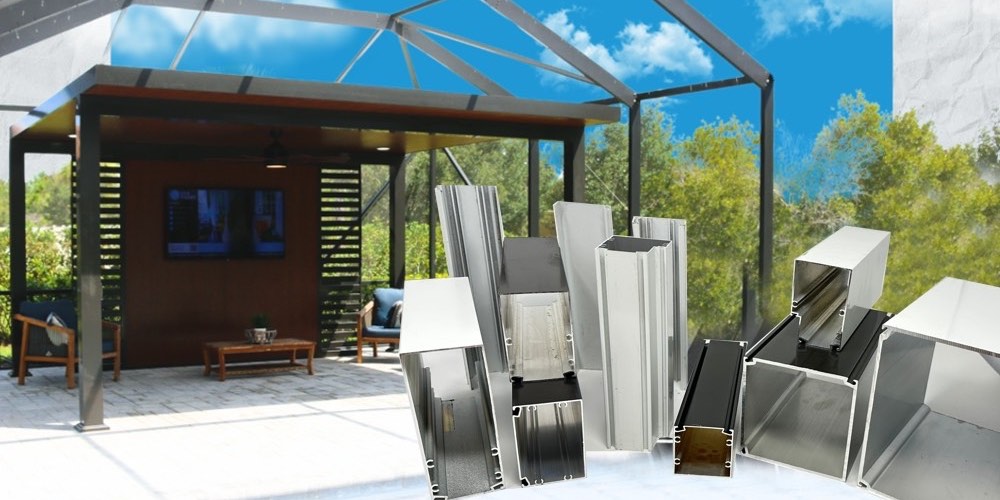
Screen enclosure framing comes in extruded aluminum profiles sized by their cross-section dimensions. The size you choose depends on the span, wind load requirements, and local building code.
Available profile sizes (width x depth in inches):
| Profile | Typical Use | Max Span (approx.) |
|---|---|---|
| 4 x 1.56 | Small window screens, infill panels | Short spans only |
| 5 x 1.56 | Residential pool cages (standard) | Up to 12 ft |
| 6 x 1.56 | Larger pool cages, commercial | Up to 16 ft |
| 7 x 1.56 | Wide-span residential | Up to 18 ft |
| 8 x 1.56 | Large commercial enclosures | Up to 22 ft |
| 9 x 1.56 | Heavy commercial, high wind zones | Up to 26 ft |
| 10 x 1.56 | Maximum span applications | 28+ ft |
All profiles are stocked in White and Dark Bronze powder-coat finishes. Standard lengths are 20 ft, 24 ft, and 30 ft.
Contractor tip: Order the longest length your truck can carry. Cutting waste on a 30 ft stick is almost always less expensive than splicing two shorter pieces, and the joint is a potential failure point in high-wind events.
Wind Load Requirements by Florida Region
Screen enclosure framing size is driven by the design wind speed for your project’s county. The Florida Building Code divides the state into wind zones, with the strictest requirements applying to the High-Velocity Hurricane Zone (HVHZ):
- Miami-Dade & Broward (HVHZ) — Design wind speeds of 175+ mph. Screen enclosures typically require 7″ or larger profiles, heavier-gauge wall thickness, and engineered anchor plans. Product approval documentation is required for permit submission.
- Palm Beach, Martin, Collier, Monroe — 170-180 mph design winds. 6″ and 7″ profiles are common for residential pool cages.
- Tampa Bay, Southwest FL, Treasure Coast — 150-165 mph. 5″ and 6″ profiles cover most residential spans.
- Central and North Florida — 140-150 mph. 5″ profiles are standard for residential pool cages.
Always confirm the specific wind speed and exposure category for the project’s parcel before finalizing profile selection. See our hurricane-rated outdoor structures guide for detailed FBC compliance information.
Screen Mesh Options: Which Type for Which Job
The screen mesh you specify affects visibility, airflow, insect protection, and durability. Here are the four main options:
18/14 Perfect View — The industry standard for residential screen enclosures. The 18×14 mesh count provides reliable insect protection with good visibility and airflow. This is the default choice for most pool cages and patio enclosures in Florida.
20/20 Perfect View — A finer mesh that blocks smaller insects, including no-see-ums (Culicoides), which are a persistent problem in coastal and marshy areas of South Florida. Slightly reduced airflow compared to 18/14 but significantly better insect protection. Specify this for waterfront properties and areas near the Everglades.
Florida Glass — A vinyl-coated fiberglass screen that provides an almost glass-like clarity. Popular for enclosures where the homeowner wants an unobstructed view — pool cages overlooking water, golf courses, or landscaped yards. Not as durable as aluminum mesh but delivers superior aesthetics.
Perfect Pet — A heavy-duty screen engineered to resist damage from pet claws and impact. Essential for any enclosure where dogs or cats have access. The reinforced construction adds cost but eliminates the most common callback in residential screen work: pet damage to standard mesh within the first year.
All screen mesh is stocked in 100 ft rolls for efficient job-site coverage.
Fastener Selection: Stainless Steel Is Required
Every fastener in a Florida screen enclosure must be Type 304 or 316 stainless steel. Galvanized or zinc-plated screws will fail within a few years due to galvanic corrosion against the aluminum — and the failure mode (screw head snaps, frame separates) is exactly what fails inspections and causes warranty callbacks.
- Type 304 stainless — Acceptable for most inland installations
- Type 316 stainless — Required for oceanfront and salt-spray-exposed projects; contains molybdenum for superior chloride resistance
- Tek screws with neoprene washers — Standard for screen-to-frame attachment; prevents water ingress at penetration points
Never mix fastener types within a single assembly. The cost savings from cheaper screws are trivial compared to a callback that requires re-screening an entire panel.
Gutter Integration: Super Gutters for Screen Enclosures
Florida’s rainfall — averaging 54 inches per year — demands proper drainage on every screen enclosure. Our Super Gutter system integrates directly with screen framing profiles:
- 5-inch Super Gutter — standard residential (lengths: 24 ft, 30 ft, 40 ft)
- 7-inch Super Gutter — high-volume drainage for large enclosures (lengths: 24 ft, 30 ft, 40 ft)
The 40 ft length is a significant advantage on larger jobs — fewer joints mean fewer potential leak points and faster installation. For premium projects, see our copper gutter spec guide.
Common Installation Mistakes
From what we see on returned materials and contractor feedback, these are the costliest avoidable errors:
- Undersized profiles for the span — 5″ profile spans exceeding 12 ft will deflect under wind load. Step up to 6″ or 7″ when in doubt.
- Mixed fastener metals — Any non-stainless screw in the assembly causes localized corrosion that spreads.
- Screen too tight — Over-tensioned screen puts stress on the frame and fails in the first major storm. Follow the splined groove tension guidelines from the mesh manufacturer.
- No expansion gaps — Aluminum expands roughly 1/8″ per 10 ft for every 50°F temperature change. Rigid installation without thermal allowance causes oil-canning and joint fatigue.
- Wrong anchor for the substrate — Concrete, block, wood framing, and metal each require different anchors. Mismatch is the most common reason for failed inspections in HVHZ counties.
Sourcing Screen Enclosure Materials in Florida
When evaluating a screen enclosure supplier, contractors should consider:
- Stocking depth — Does the supplier carry all 7 profile sizes, or do you wait 2 weeks for a special order?
- Lengths available — 20, 24, and 30 ft stocked means less waste and fewer trips.
- Location proximity — Delivery cost and pickup convenience directly impact your per-job margin.
- Wholesale pricing — Retail-oriented suppliers mark up 20-40% over wholesale. Make sure you are buying from a true wholesale distributor.
Classic Metals Suppliers stocks all seven profile sizes, four screen mesh types, and Super Gutter systems at four Florida locations: Opa-Locka (92,000 sqft), Miami, West Palm Beach, and Tampa. Call (305) 822-7737 or toll-free (888) 638-2501 for contractor pricing.
Frequently Asked Questions
What profile size should I use for a standard residential pool cage in Central Florida?
For spans up to 12 feet, 5 x 1.56 is the industry standard. For wider spans or HVHZ counties, step up to 6″ or 7″. Always verify against the project’s specific wind zone.
Is 18/14 or 20/20 screen better for South Florida?
For coastal and Everglades-adjacent properties, 20/20 blocks no-see-ums that 18/14 lets through. For inland central/north Florida, 18/14 is typically sufficient and offers better airflow.
Can I use galvanized screws instead of stainless steel to save cost?
No. Galvanized fasteners against aluminum cause galvanic corrosion and will fail within a few years. Type 304 (inland) or 316 (coastal) stainless steel is non-negotiable.
Do screen enclosures in Miami-Dade require product approval?
Yes. HVHZ counties require Florida Product Approval (FL#) or Miami-Dade NOA documentation for the framing system, fasteners, and screen mesh. Your supplier should be able to provide this paperwork with the order.
What’s the longest screen enclosure length I can order without splicing?
30 ft is the standard longest stocked length. For jobs requiring longer unspliced runs, cut-to-order options are available with 1-2 week lead time.
Get Screen Enclosure Materials for Your Next Job
Call (305) 822-7737 or toll-free (888) 638-2501 to order screen enclosure profiles, mesh, fasteners, and Super Gutter systems from the nearest Classic Metals location.
Related reading: How material delivery works | Hurricane-rated outdoor structures | FBC compliance guide